
Case study · Battery sales and service shop
Battery Charge & Check
From handwritten charge-and-check sheets to a searchable record of every battery that comes through the door.
- Client
- Battery sales and service shop
- Status
- In daily use
- Delivered
- Desktop app, web app, phone test entry, digital receipt archive
The challenge
When a customer brings in a battery, the shop charges it, tests it and decides whether it is good, needs replacing, or qualifies for a prorated warranty. Every one of those checks was recorded on a paper charge-and-check sheet, with hydrometer readings written in by hand after the label was printed.
Paper worked until it didn't. If a sheet was lost or damaged, the record of that battery was gone, along with its test history, the loaner it went out with, and the prorate amount the customer was owed.
What we built
We moved the whole process into a database, so a ticket exists whether or not its paper does, and built the tools the shop needs around it.
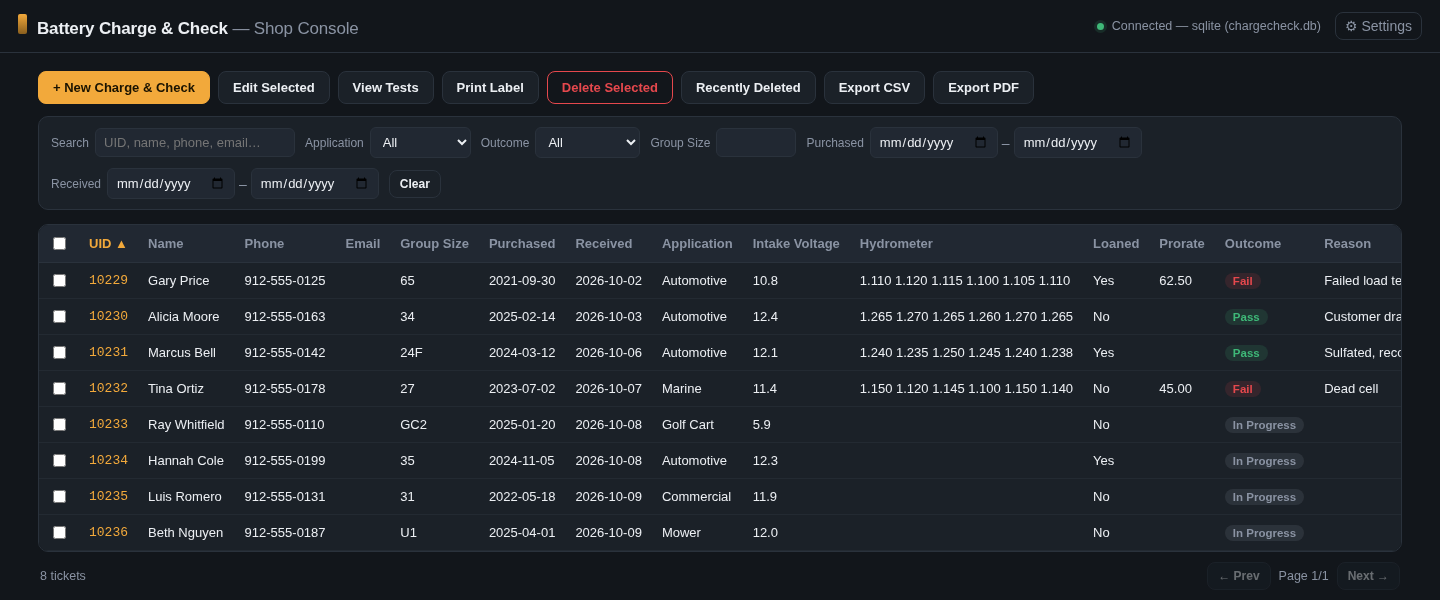
- One record per battery. Customer, group size, purchase and intake dates, application, intake voltage, hydrometer readings, loaner, prorate amount, outcome and reason, all in one ticket.
- A test log for every ticket. Voltage, load test and hydrometer results are logged with the date and time against the battery they belong to.
- Search that finds things. Search by name, phone or ticket number, and filter by application, outcome, group size or date range.
- Printed labels from the record. Ticket labels in two sizes print straight from the data, with hydrometer readings filled in instead of handwritten.
- Test entry from the bench. A phone and tablet page lets a technician pick an active battery and log a test without walking back to the counter.
- Reports and a safety net. Export any filtered set of tickets to CSV or PDF. Deleted tickets go to a Recently Deleted list and can be restored.
Built to keep running
A tool the counter depends on all day can't fall over when the network blinks. The apps reconnect to the database automatically and retry if the connection drops, and the database password is encrypted on disk instead of sitting in a settings file.
All three apps (the desktop console, the browser version and the bench page) share one database and the same validation rules, so a test entered on a phone is checked and stored exactly like one entered at the counter. The shop can start on a single computer and move to a PostgreSQL server as it grows, without changing how anyone works.
Paperwork, too: a digital receipt archive
When the shop switched payment processors, they found the new card terminal didn't connect to their point-of-sale system. The only record of each card payment was the receipt the terminal printed, so every one of those slips had to be kept. A lost receipt meant a payment with no record behind it.
We set up Paperless-ngx, an open-source document management system, on the same server that runs Battery Charge & Check. Staff photograph each receipt with a phone app, where it is scanned, labeled and tagged. We tuned the text recognition (OCR) for the terminal's receipts, so any receipt can be found by searching for what is printed on it.
No new hardware, no monthly subscription, and the receipts stay on the shop's own server.
The result
Every battery the shop checks now has a permanent, searchable record. Test history, loaners and prorates are tied to the ticket instead of a sheet of paper, labels print from the data, and technicians log results where the work happens. Card receipts are stored digitally and can be found in seconds by searching.
Is your shop still tracking work on paper?
We build tools around the way your team already works, then set them up and keep them running.
Start a Project